
A University Student’s Balanced View on Technology
Liwen is a 20-year-old undergraduate at a local university, studying alongside ambitions to become a teacher. She lives with her parents and younger brother; her mother holds a science degree and her father has a medical degree. In her everyday life, she relies mainly on her phone and occasionally uses smart home devices such as Alexa. She describes her knowledge of AI and robots as sufficient to engage with the topic, without claiming deep technical expertise.
They have a very fast pick-up rate — when AI first starts to learn information, it studies very quickly, recognises patterns and replicates them.
The Future She Hopes For
In 2050, Liwen hopes to be working as a teacher, though she wonders whether she will have the energy to sustain it long-term. Above all, she wants a happy family, a working spouse, and a life of sustainability — contributing to her community through volunteering. For society at large, she hopes for harmony: “It would be great if everyone can live together in harmony — that would be good.”
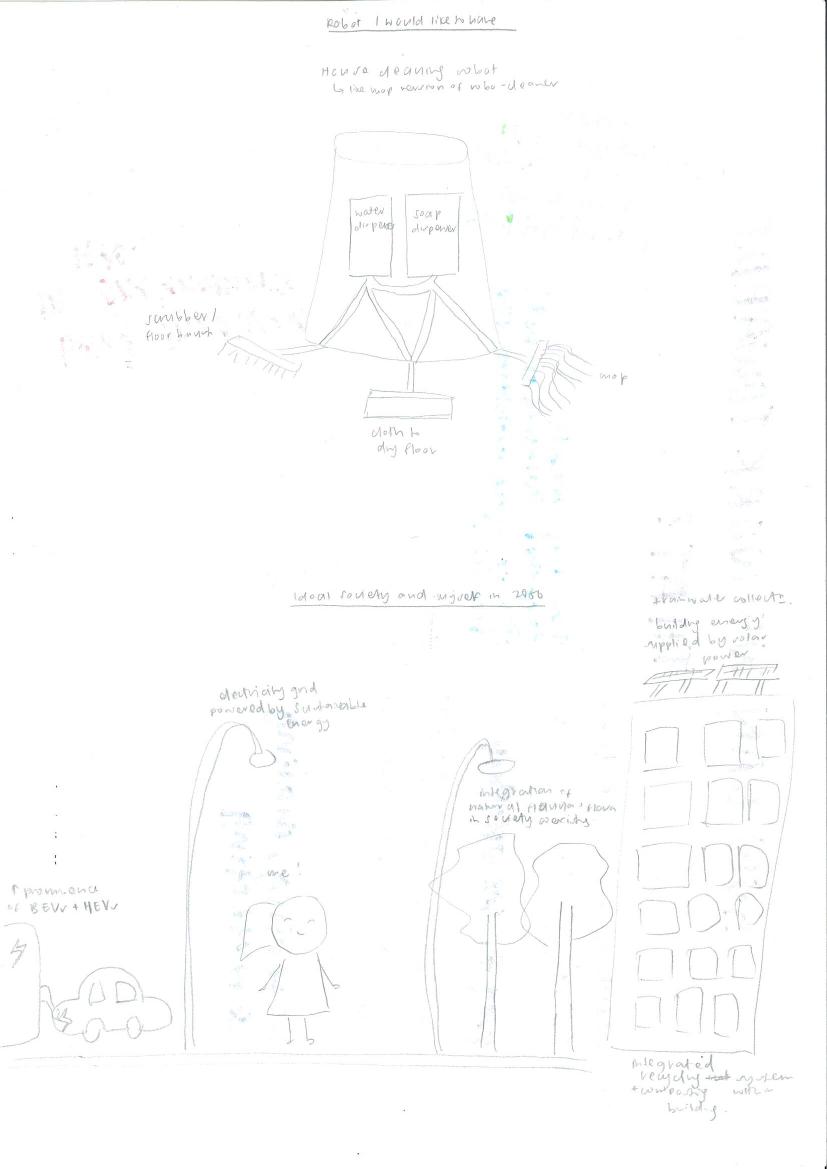
She welcomes the integration of sustainable energy, electric vehicles, and greener practices into daily life. Her vision of AI’s role is fundamentally pragmatic: technology should address the “pain points” in society — doing the things people find annoying or exhausting to do themselves.
At Home: Yes to Housekeeping, No to Childcare
Liwen is enthusiastic about AI and robots in the domestic sphere, particularly for housekeeping. Mopping, vacuuming, washing dishes, switching on lights — these are tasks she would happily delegate. She already sees value in smart home ecosystems like Google Home.
However, she draws a clear line at childcare. Children, she believes, need to develop interpersonal human skills through real human interaction during their developmental years — something robots are not yet equipped to provide.
It’s important that during those developmental years, children interact with humans.
For elderly care, she is more open: 24/7 monitoring of vitals and blood pressure for elderly living alone could be genuinely life-saving. She is also positive about AI nurses handling logistical tasks, though hesitant about robot-led medical procedures such as vaccinations. On robots as pets, she has no interest — though she would welcome robot systems that help care for real pets, such as automated feeders and monitoring cameras.
Human Judgment Where It Counts
In education, Liwen is clear that teaching and student assessment require human judgment. AI can mark multiple-choice answers and filter entrance applications to reduce workload, but qualitative essays and the nuanced assessment of individual students should remain in human hands.
Similarly, in the workplace, AI can be useful for filtering CVs and matching applicants to roles — but final hiring decisions require the kind of interpersonal discernment only humans can offer. She finds AI colleagues “bizarre,” and is sceptical of AI as clients, as she cannot imagine a robot initiating requests independently.
On the broader societal level, she opposes AI judges and AI in political decision-making, both of which she sees as too human and too nuanced for algorithmic processing. She does, however, support AI in surveillance for crime detection, triage and emergency services, environmental sorting systems, and military detection roles.
Trust, Nuance, and the Human Touch
Liwen rates her trust in AI at around 65%. She acknowledges their speed and capability, but insists that human judgment must remain in the loop — particularly in cases where AI could spiral out of control if poorly monitored. She finds chatbots irritating in customer service contexts, where she simply wants to resolve an issue quickly with a real person. Yet she sees genuine value in AI translation and in systems that help process large volumes of data.
Reflecting on a Black Mirror episode exploring memory augmentation, she concludes that intelligence implants feel “like trying to play God” — and that there are reasons why humans don’t possess all knowledge. Her preferred robot design? Something clearly non-human: “I find it creepy if they look too much like a human.”
