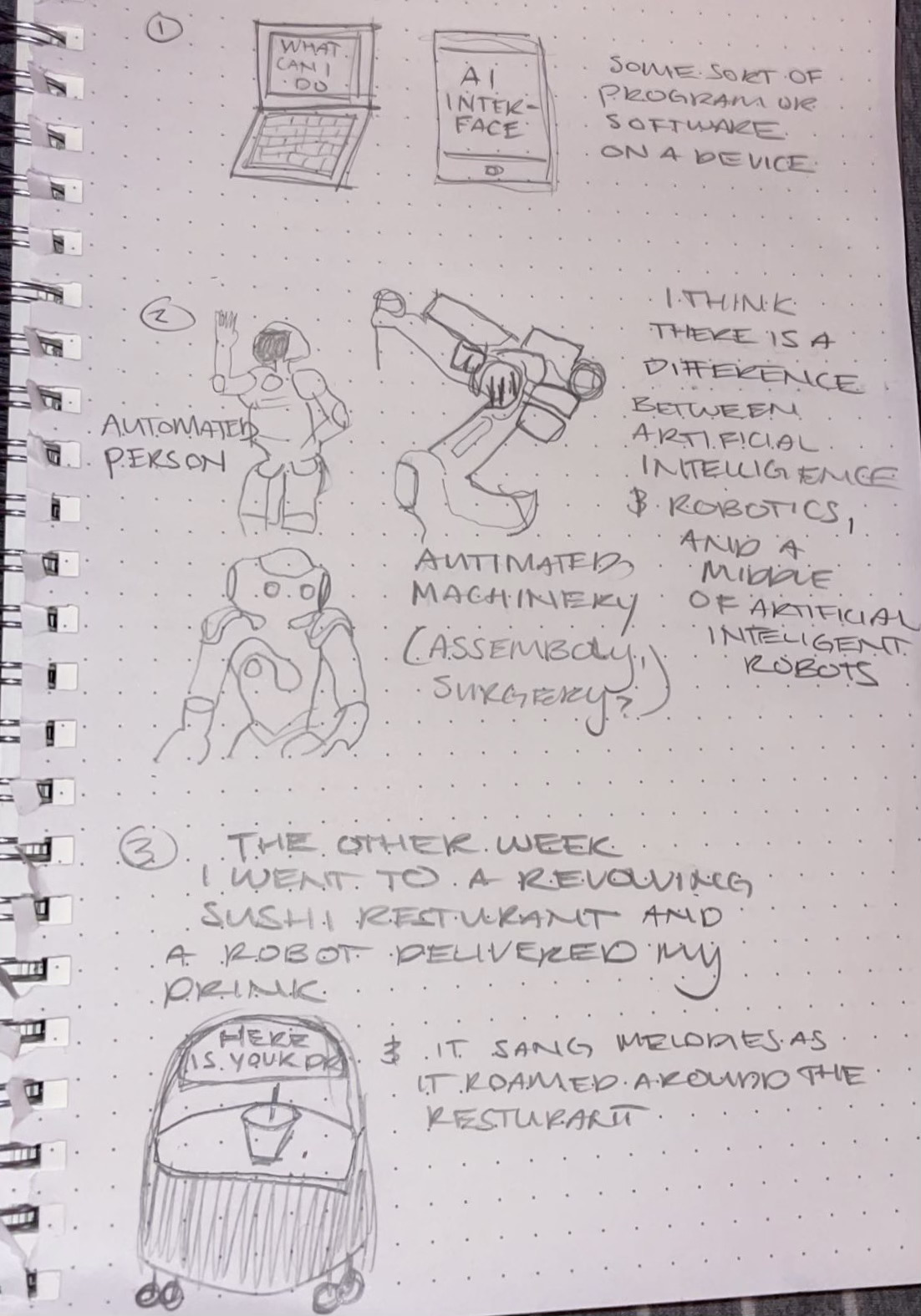
Lily is 20 years old and a student at a community college in Northern California, where she is studying communications. Her parents both work full-time. She encounters AI mostly through software and digital tools rather than robots — the most vivid exception being a visit to a revolving sushi bar in San Francisco, where a robot delivered her drink while playing little melodies as it roamed the restaurant. “It was really disorienting but really interesting,” she says.
Sustainability, Creativity, and an Uncertain Future
Lily is still figuring out her path. She is drawn to design, photography, and architecture — fields where she feels AI cannot fully replace the human creative voice. By 2050, she wants to be financially independent, with her own solar and water systems, living sustainably. Her view of society in 2050 is anxious but hopeful: “The political climate and environmental climate are not really great right now and it’s kind of concerning. But I hope it’s in a more positive multicultural direction.” Virtual reality, she believes, is going to keep growing — possibly becoming a necessity for daily work and tasks rather than just entertainment, though she is uncertain whether that is a good thing.
The Smart Home She’d Actually Want
The AI Lily finds most appealing is integrated into the home in subtle ways: a central system that regulates heating, scans for health risks as you walk in the door, helps with cooking, gardening, and repairs. “I’m sure there could be a lot of kitchen-aid robots — fun to develop, help around the house, or with gardening.” She is enthusiastic about VR’s potential, but also wary of dependence. On implants for intelligence augmentation, she is skeptical: “That would almost create an even bigger disparity between people and communities who have access to enhance themselves artificially.” Translation robots, on the other hand, she thinks are already close to useful — she read about earphones that translate in real time and finds that genuinely exciting.
Jobs, Compassion, and Drawing Lines
Lily’s instinct on many AI questions is “yes and no” — a phrase she returns to often, and one that reflects her genuine ambivalence. She welcomes AI in hospitals for tedious tasks (measuring pills, lab work, processing data), and can imagine robotic assistance in surgery when a doctor uses specific machinery. But she draws a clear line at compassion: “Robots can’t compute compassion. I think that’s a big thing of what older people need.” For the nursing home context, she feels human staff must always be present alongside any AI system. In shops, she prefers human salespeople — “I like being able to speak to somebody and get their opinion, unbiased, with their own sense of style” — while acknowledging that AI-assisted fitting rooms already exist and impressed her during a visit to a mall in Los Angeles.
Trusting Intentions, Not Just Systems
On the question of AI trust, Lily is philosophical. “Yes, if the corporation that made the AI had really positive, good intentions — in that case I would trust it. But if it’s for just a money-profiting scheme, not necessarily.” She is also worried about over-reliance: “All this technology is becoming more reliant and it’s distancing us from our true nature and how we operated before technology.” Her preferred robot shape is non-organic — something that is clearly a machine, not pretending to be alive. “A human-looking android would give me the heebie-jeebies.” She remembers fondly the small, clear animatronic dog pets from the early 2000s — something lifelike but obviously mechanical.
Creativity, Anthropology, and What Can’t Be Replaced
In 2050, Lily hopes to work in a creative field — architecture, interior design, photography — that robots can assist but not replace. “You’re expressing yourself in your work, and I don’t think robots could be creative in that way.” She believes AI will eliminate more jobs than it creates — pointing to factories that have already replaced workers with automated machinery — but hopes that creative, athletic, and medical roles will remain human. Her most unusual advice for the future: “The focus on the past is just as important as the future.” She took an anthropology course recently and found it revelatory, a reminder that understanding where humans come from is as essential as imagining where technology is taking us.