Interview Series: Gen Z Meets AI #20
Graduate Student in Mechanical Engineering Interested in Energy Generation
Derek is 22 years old, and has recently completed an integrated Master’s in mechanical engineering, and is soon to complete another Master’s related to energy generation. His sister is also interested in studying engineering, despite his parents having jobs unrelated to the topic: his father is an accountant, and his mother works as a clinical governance manager; she has a law degree that she uses to investigate the NHS. He has used AI in social media, as well as chatbots on different websites, and uses speed recognition devices, such as Siri and Google, to play music. While he has a car, it doesn’t have any self-driving features.
Hopes for a Sustainable Society and Lifestyle Transformation
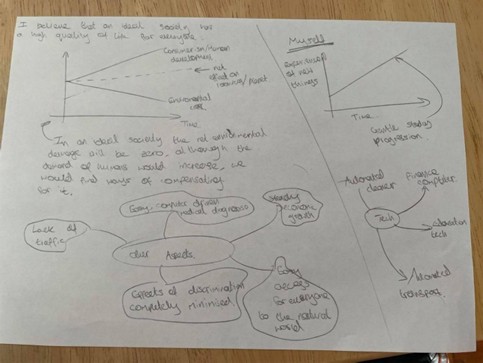
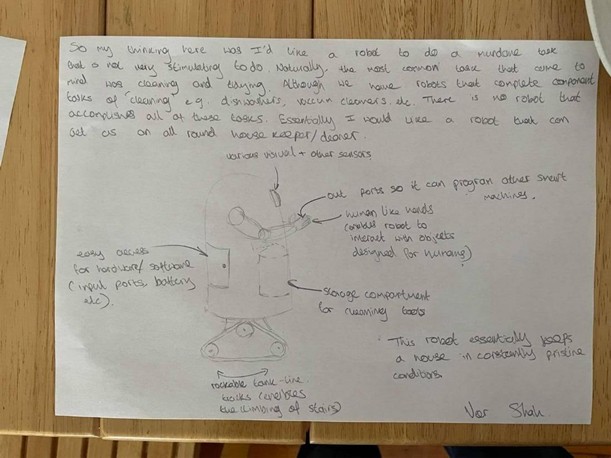
Derek’s dream for 2050 is to work a job he’s interested in, rather than working as a means to survive. He’d like to have enough time in his lifestyle to exercise and enjoy things outside of work and hopes to be able to break out of the average 9-to-5 job. He would like to live in a society which is good for the environment and prioritises sustainable development, as well as one which provides more focus on people’s mental health and erases forms of inequality. In his vision, since prejudice seems to be a generational thing that needs a change of mind, he is sure this hope would be achieved by then. He enjoys driving, so he would not like to have a self-driving car, but he would like a robot that could take care of mundane tasks at home, once again feeding back to him wanting more personal time.
Complex Feelings About Robots and Technology from Movies
Within the movies he’s seen, Derek’s association with robots comes from shows like Star Wars, where robots are often protagonists of the story, but subordinates to humans. He has mixed views on technology overall, where it can be beneficial but also has downsides. In his understanding, a robot is associated with stuff like a mechanical arm, a cleaning machine, something related to what he’s seen in sci-fi, while AI is considered more clever, and consists of code which makes tasks automated.
Concerns About Robots in Childcare and Pet Care
When it comes to childcare, Derek does not seem to see a point of having a robot to take care of any children, since he doesn’t see the point of having offspring if you have no intent to look after it. In his opinion, people have children because they enjoy the process of raising them and seeing them grow as their own people. He has a similar view of having robots to look after pets, since people get them with the intent to look after them and make them part of their family. He also disagrees with the idea of having robot pets, since there would be no emotional attachment. Overall, the only time he’d like a robot to help with pet care is to help with small tasks, such as cleaning up after them. Similarly, the only time he’d like robots at home would be as small applications. He insists that it is good for humans to interact with each other, as having someone to talk to and have an emotional connection, which is why he disagrees with roles such as teachers being taken by machines, although he would like AI to mark papers and exams, as it would be quicker and would remove bias. A similar opinion is held towards medical staff: while it would be more comforting to have a human doctor, a robot would be able to search through its records and find a diagnosis that matches the most, while humans can often be mistaken.
Proposals for Maintaining Human Roles Amid AI Adoption at Work
Before any other work, Derek said he would appreciate having AI to filter through job applications in the first place, as it would remove stuff like racial bias and be able to quickly sort through if someone’s experiences are relevant, even though this has the downside of people using certain buzzwords to their advantage within the program. He says that some areas, like a café, are places where people visit due to the value of human interaction, so having robots working there would defeat the whole purpose. For both hospitals and nursing homes, people could be uncomfortable by robots working there based on personal preference, so there should be human workers there as well if an individual may want a second opinion, but Derek said that robots should be capable of the work required, such as basics of being cared for. In general, the rule he set is for robot to do the analytical work if capable, while humans should still make decisions, especially in law and politics, and sees AI as being used to find evidence in cases. However, all of these opinions could change depending on how good the available technology would be at completing said tasks.
Possibilities for Robots in Self-Driving Cars and Environmental Protection
Derek envisions there being guidelines and standards in the development of self-driving cars, and so any accidents or problems would most likely occur due to people misusing them, otherwise they would be safe to use. He doesn’t mind delivery drones being used as long as the environment is not harmed in the process. He is comfortable with the idea of CCTV being monitored by AI, although he wants to be sure the security relating to it will prevent any data breaches. In emergency situations, especially where first response is needed, he would like AI to be present: it would make decisions quicker without shock clouding judgement, and therefore professional attention would be provided sooner. When it comes to foreign countries, small meetings could use translator apps to communicate and make decisions, but these apps shouldn’t be trusted for larger scale and more serious conversations, since mistranslations could have a massive impact and we shouldn’t give a chance for the apps to be inaccurate. He is comfortable with AI being used in the military if the technology is good enough, as well as politics, but would like to only use robots for environmental protection if the reward is good and if the risk is not that bad.
The Need for AI Education and Adapting to Future Society
Personally, he would like to learn how to make AI, or how to write the script for one, so he believes that students should be taught programming skills early on. He sees it as a shame that he was not taught such skills, and so wishes it would be taught in depth to children, especially with the future leading towards more automation; people need to learn how to navigate and develop such machines from an early age so that they can grow up accustomed to such things. He stated that as technology develops, more “low level” jobs would be taken over by robots, so people need to be able to receive education required to still be able to find jobs even in that work environment, such as to make people qualified engineers to help maintenance of such machines while they take over roles humans could have done otherwise. Derek has said he accepts technology in a more proactive way, and hopes that future developments can help improve people’s mental health and make society more progressive as a whole, since people could focus on self-care and communication with people of all backgrounds while AI take care of chores, improving our quality of life and understanding of others. Overall, he looks forward to AI eliminating bias, as well as calculating issues and making decisions based on said calculations.