
Interview Series: Gen Z Meets AI #22
Preferences for Technology Use at Home
Miles is 17 years old and is about to start Year 13 at school. He lives with his parents, where his father is a CTO and his mother is a private tutor, as well as with his younger siblings. Although it is difficult to define robot technology, where he is unsure if technology such as microwaves or kettles are included, he experiences it with his phone, which optimises charging and uses Face-ID as long as his mask is off. There is also an Alexa in the living room which is mostly used for playing music. On apps such as Spotify and YouTube, he likes recommendation algorithms that can recommend music or videos similar to genres and creators you enjoy but mentions that it must be difficult for Netflix to recommend movies and shows, as it needs more information than just genre.
Dreams of Becoming a Diplomat and Hopes for Future Society
In the future, Miles would like to go into diplomacy as a career and says that AI shouldn’t be able to take it as it is entirely reliant on human-to-human interaction. He is planning to study history and politics at university so that he can go into the civil service, as a steppingstone for his dream job. He likes how his lifestyle is now and doesn’t think it is realistic to think that 2050 will be much more futuristic than our current society is. Technology will only be a more advanced version of what we already have as opposed to completely new and different creations. Although society will also be mostly similar to how it is now, he hopes that the improved technology we will have will succeed in improving people’s quality of life.
AI and Robot Images Shaped by Movies
Miles defines AI and robots by movies he has seen. AI is something humanoid that can speak with us and complete tasks, looking identical to people most of the time. Meanwhile, robots are thought of as childhood toys which consist of square shapes, although more adult movies show them to be incredibly similar to humans too. His main association with AI is from the Iron Man movies, where there is a fascinating assistant called Jarvis. Robots don’t have a specific association but are generally shown as negative and tend to go rogue throughout the story. While he thinks that current technological developments are good, he is concerned about what problems future developments may involve, such as once they become indistinguishable from humans.
The Role of Home Robots and Views on Childcare
As Miles likes already existing robotic vacuum cleaner, he would like cleaning robots to be more widespread among households but says that complex tasks with several steps still need to be done by humans. When asked about childcare, until they are one year old children need to be taken care by and interact with humans only, while after that it depends on how advanced the robots are and what tasks they can be asked to do, perhaps having separate robots for separate roles such as feeding and playing. In fact, he goes as far as to say that as long as a robot can take care of a child well, where it survives and develops well, human parents may not be needed at all. For healthcare monitoring, while he has a Fitbit which tells users it is not a health device, he would like an app that can diagnose issues and tell you if it is something you should go to a GP for. He has mixed feelings about elderly care, since he is unsure about whether robots would be able to speak with humans to simulate social interaction but acknowledges that they could be used to make people be able to live independently and help make their lives easier. Miles lives with two dogs and thinks that robots could be used to look after pets for a limited time only, perhaps only a few days. Robot pets make him uncomfortable though, as it would be immortal and difficult to form an emotional attachment with. Finally, while robots can teach, they cannot manage children as there would be no respect for a machine as for a teacher, but they can be used to mark assessments with multiple choice and maths questions. However, subjects such as history are already difficult to mark, and he expects robots not to take that role as it would only be more to program
Concerns About Robot Introduction at Work
Miles would not like work recruiters to be robots, preferring for them to be members with experience in the field, since it would be easier for them to assess what they are looking for. He would only like AI colleagues if they acted as assistants as opposed to people to discuss with. AI clients would make him feel disrespected in his career, mentioning how he will have gone through so much work just for a robot to come to him. When asked about robotic retail stores, he mentions that it already exists in the form of Amazon shops, where people come in, pick up items and leave without paying, and their Amazon accounts are simply charged instead. Restaurants can also be run by robots, since people are only needed to collect the food ordered. They would also be cheaper to run if the chefs are robots instead of someone who has had a lot of training throughout their lives. In hospitals, he would like machines to be able to scan and diagnose with issues, as it would be a quicker procedure and more accurate, and they should be able to complete surgeries too, being more accurate than a human. The only time humans would be needed is when the issue is mental health related or someone needs to be social, such as in care homes. He brushes off needing human doctors and nurses, saying that a hospital is not a place to be social in but to be cured, so it’s better to have the most efficient method to achieve that. He says it may reach a point where we need less doctors because people will just ask for updates from machines.
Expectations for Self-Driving Cars and Public Transport
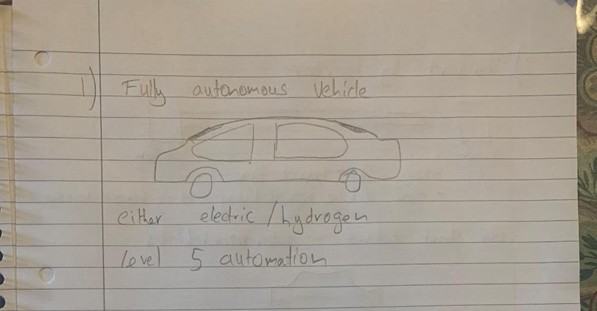
While Miles would like self-driving cars, he thinks that them being fully autonomous is unrealistic to achieve by 2050, and a less advanced model may be present instead. He trusts technology to be safer to drive than if humans are in control, since humans can be affected by alcohol, tiredness, and other issues. He also mentions that trains are already capable of being self-driving and says that the only reason they are not, is because people need work. It should be easy to incorporate self-driving vehicles into public transport as there are less vehicles to replace, and all people would be needed for is to check the status and ensure that everything is running properly. Similar to how trains already have the capability to be self-driving, planes only have pilots to reassure passengers that people are present in case something goes wrong. Having delivery drones would be fascinating, but Miles is concerned about the workforce and how difficult it would be for packages to travel far distances. While we could use automated trolleys on the ground to prevent deliveries being dropped, it would be difficult to prevent them from being stolen. In more social areas, such as judgement and politics, we need humans to make decisions so that people may accept them and be satisfied with the decision. This is more apparent in international situations, which have a much higher stake in their decisions, and so should absolutely not use robots. He is also unsure about the use of CCTV, since it is a matter of how much privacy people are willing to give up for the sake of security. He would like for biometrics and automated facial recognition to be used, especially when passports are checked in airports as it helps avoid queues, making the entire process quicker. First response situations need a mixture of robots and people, such as making paramedics and robots firefighters but also having human staff travel with them to communicate with victims and provide comfort. However, while police wouldn’t have human lives put in danger if they were robots, they may also be less respected by the public. On a more global level, Miles likes translation software and mentions how it is much more accurate than it was years ago, although finds issues with it being difficult to translate tone and emotion to others. While robot soldiers would be good to use in dangerous scenarios to protect human lives, the unfortunate fact of wars is that their purpose is to kill people, so it wouldn’t make sense to have robots fight robots in them. Finally, he would like us to use robots to help with the environment as long as there are more benefits than losses. For example, we could have AI monitor energy usage and demand and be in charge of generating electricity, or we could have machines to clean up oil spills and other water pollution.
Insights on Changes in Education and the Labor Market
Miles would like to learn more about the development of the advancements of technology, and thinks that, once they are a common aspect of society, we will have no choice but to teach about it in school. Due to differences in the job market after implementing robots, he also expects the education system to change, and thinks that peeople will need to begin training for specialist jobs earlier. He didn’t like online teaching in the pandemic, mentioning that part of the reason for school is to socialise and make new friends. He is also unsure about robot teaching, because even though it may be good for higher education where lecturers don’t need to worry about managing students, it may cause disagreements between whether robots should teach or professors who have studied subjects for years and deserved their qualifications. This may also lead to robot-taught and human-taught courses, which could lead to discrimination between people who attended either once they believe they received the best education. Miles thinks of a job as something done that people enjoy and also allows them to earn money to support themselves and families, and although the amount of low-level jobs will decrease, high-skilled jobs will increase in demand. However, the overall number of jobs will decrease. Miles believes that human happiness comes from a balance of different areas of our lives, but the priorities lie in leasure, career, and family, so we should ensure people can pursue whatever interests they like and lead whatever lifestyles they enjoy. This means that we should make the use of robots optional and keep options open for people – for example, if we develop cooking robots and someone enjoys cooking, there should be the option for them to not use such robots.
