Interview Series: Gen Z Meets AI #21
AI Use and Efficiency in Daily Life
Kendall is 24 years old, is currently working on her PhD, and works in a school as administrator. She currently lives with her parents and brother, where her mother is a teacher, and her father works as a head advisor in a consulting form. The only technology Kendall uses are her laptop and phone, for both work and university, and she likes using AI that can memorise her routines and can tell her how she’s doing for the day. She also has a Google Nest to listen to podcasts and uses Siri in her day-to-day life to help when she cannot access her phone, such as asking to convert measurements while cooking. While she has a licence, she does not drive.
Future Plans for Living in Harmony with Nature
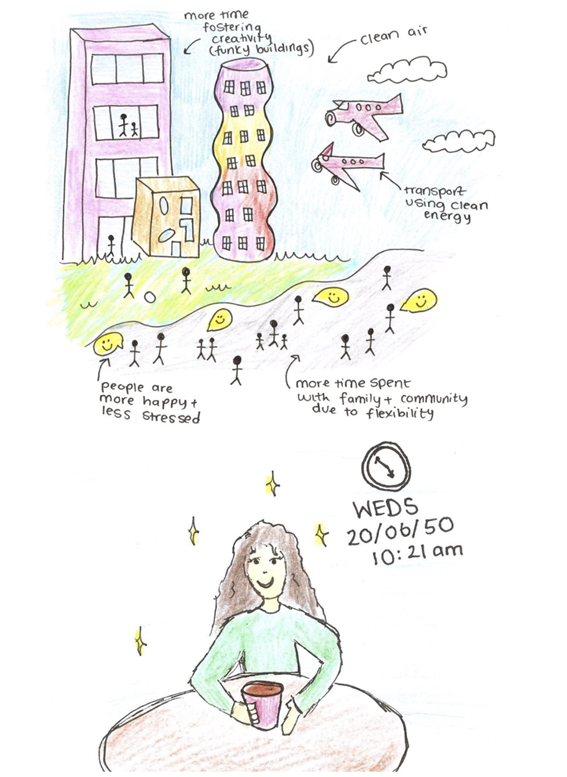
In the future, Kendall would like to have a nice house in the countryside, where she can be ecologically friendly alongside nature. She would like to work in a job that makes her happy and allows her flexibility in her life and would like to participate in various projects she may enjoy, such as a research consultant, teacher, architect, or interior designer. Overall, Kendall has a negative perspective of AI and robots, as a lot of media depicts it as something dystopian but would like robots to make parts of life easier, especially if having robots in jobs allows for people to pursue their interests as a career instead.
Robot Images Shaped by “WALL-E”
Kendall sees AI as everyday technology, which is more abstract to define but can be implemented everywhere as software. Robots are viewed as more mechanical, perhaps humanoid, and she imagines they would be hot to touch and create a buzzing sound. All of her associations with such technology comes from science fiction and the news, where her most prominent piece of media is the movie Wall-E, a story of how technology ruined humans and the earth.
Proposals for Household Support by Home Robots
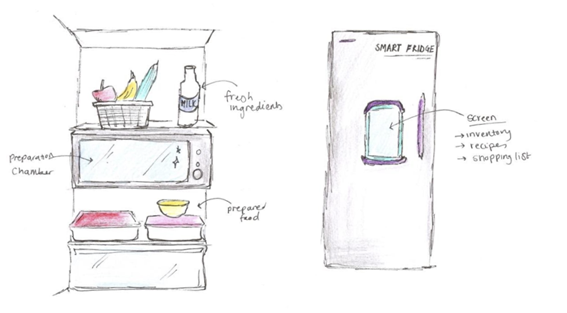
Because of her time at work and in her studies, Kendall does not have a lot of time for doing stuff at home. Therefore, she would appreciate having technology help with home tasks. One of her ideas is to have a fridge that could track food inside and let you know when it is about to expire. Another concept she would like is to have a robot that could pay for you, where you’d use your fingerprint to confirm a payment and it would exchange money from your bank account. In general, she expresses a desire for a robot who can remember your routine so that they could assist in various chores, such as cleaning your house. Outside of just what a robot could achieve in the household, Kendall has other ideas for areas that could use improvement as well, including having robots assisting in libraries, perhaps to help in finding and organising books. When it comes to childcare, she notes that using a mobile phone and other such technology is already used to entertain pets, so as long as there is a camera for her to check on the child she doesn’t mind if similar ideas are incorporated with children. As a child, Kendall had both real and robot pets, in the form of hamsters and Tamagotchi, which she enjoyed because the machine would simply restart as opposed to having the pet die, but also isn’t sure if it would be possible to have such a strong emotional attachment to technology. She would be upset if her Tamagotchi stopped working but thinks that is just due to nostalgia. For schoolwork, Kendall thinks that robots could be used to mark mathematical subjects, where the answers can only be right or wrong, but isn’t sure abouKendallys, as it would take away the essence, so she would prefer a human.
Hopes for AI Assistants in the Workplace
While Kendall would embrace AI at work, she would prefer for it to be an assistant as opposed to being considered a colleague. She would also prefer to have humans serving in restaurants and cafes, as she insists such environments are meant to be social, and it’s now a part of her morning routine to say good morning to a worker. Meanwhile, most customer service consists of similar routines, so Kendall said that putting robots in those roles would be useful, especially in the case of refunds – she already uses self-checkouts as they are quicker to use than to wait for someone else to scan all the food. However, she would still like real people to be in the store, to ask for assistance and just for the store to have humans around. In hospitals, she emphasises that there needs to be trust between the doctors and patients, and nurses should be human as well, so that they can feel welcoming and provide patients with a sense of comfort. While medication dispensing could be done by a robot, everything else in medical settings should be done by a human. A similar idea is held with regards to nursing homes and schools: while robots would be beneficial for physical tasks, there needs to be a human social setting present.
Pros and Cons of AI in Public Transport and Politics
Kendall doesn’t see an issue with self-driving cars, as driving isn’t a social experience but something that needs to be done, so human connection isn’t needed. She is comfortable with drones delivering post and packages too. Having AI monitor energy and water usage would also be a good idea, as it only involves calculations, which would be done better by a machine than humans. When it comes to a court setting, Kendall points out that our emotions could cloud our judgement, so it would be beneficial to have AI provide an objective view without bias. However, politics are a lot more nuanced, and so we would need humans to discuss issues, although, with regards to the pandemic, we could have had technology to monitor the situation and decide on when to implement lockdowns. Kendall disagrees with AI being used for surveillance, as a lot of risk is involved in her opinion, and even on social media it could be seen as authoritative to be monitored and identified. In fact, there is a mixed opinion when it comes to social media, because while freedom of expression can lead to hate speech, anonymity can be good too. When it comes to first response, we can use robots to support the workers but not to make decisions, with the only exception being firefighters, as using robots would avoid putting humans in danger. On a more global scale, AI could provide more advanced translation apps, which leads to mixed opinions. On one hand, Kendall is worried that we would result in developing a global language, which would lose individuality and cultures, but it would also be easier to understand people around the world. Meanwhile, she disagrees with using robots in military, since civilians will no longer be seen as people. Finally, when it comes to the environment, she thinks AI could be used to avoid poaching, manage wildfires, and monitor and protect wildlife.
Proposals for Technology Use in Education
In the future, Kendall would like an AI with awareness, that can help with cooking and other such tasks. She would like for people to be more educated on technology, especially ones that can be involved in day-to-day life, mentioning an example of her friend who taught her about cryptocurrency. We should start this education from a young age, where school children are taught about websites and programming, especially as a way to develop their brains and prepare them for learning more as they grow older. Kendall also expresses concern over inequalities being more obvious in a technological world, and stresses that people should be taught to do tasks themselves without the aid of technology. She sees a career as a place for the development of an individual, where they can learn skills and grow, so standardised jobs, such as drivers and pilots, can go to robots. This would allow people to work in jobs they would be interested in instead. Jobs with social areas will be more in demand, such as nurses, and although creative jobs could go to machines, out of interest of what they may produce, humans can still program the algorithms used by the machines. With the recent explosion of AI art, she emphasises that robots wouldn’t be replacing artists, but it would be an interesting experiment to see what they could create. Overall, for a happy society in the future, we need to care about other people, and make the pathway for people to pursue their interests easier, with flexible work so that they can work on personal hobbies too.