Interview Series: Gen Z Meets AI #23
Daily Life Reflecting Philosophical Thinking
Henry is 21 years old, and has recently finished an undergraduate degree in philosophy, soon to begin a Masters. He doesn’t use speech recognition technology but enjoys using software that can be used to plan routes and plays games on his computer that makes the use of AI when playing against the program, such as chess and poker, which he assumes is done with the aid of calculations, where the computer takes in inputs and creates outputs for the machine to follow, based on certain patterns.
Vision as a Scholar and Hopes for an Equal Society
In 2050, Henry would like to be an academic, while also having a nice house and a family. He hopes that technology can take over a lot of jobs that need doing, which will allow for people to do work they enjoy, as well as providing more free time to pursue hobbies and rest. Henry hopes that by then, we could all live in an equal society without discrimination, visualising that by 2050, wealth disparity will be an issue of the past. He also hopes we can live in harmony with the environment, minimising damage and being more sustainable.
Trust in AI Programs and Ethical Concerns
Henry would quite enjoy robots that would complete simple household tasks, such as cleaning the house and taking out the rubbish, allowing for more time to be spent with his family and doing things he enjoys. He also quite likes programs which learn things about you, such as Spotify or Netflix, where the apps see a trend in what genres you enjoy, and provide suggestions based on these. It saves a lot of time that would otherwise be spent searching for the perfect music or show. According to him, people dismiss the power of machines too quickly, assuming they can’t do tasks they are fully capable of doing. However, he admits they are not independent from humans, as they may reflect biases present in the people who created and programmed the AI and worries that rather than being used to help people, it’ll be used to make the wealthy people wealthier, and make things worse for everyone else. Overall, in all jobs, robots just need to be more reliable than humans, as humans make mistakes that a robot hopefully wouldn’t make. His idea of AI is that it acts like a mind, and imagines a disembodied voice, while a robot is physical and humanoid, which he admits comes from movies and he himself does not think they all look like humans. In the past, movies always made AI seem evil, but now they seem to be more ambiguous.
Proposals for Reducing Housework with Home Robots
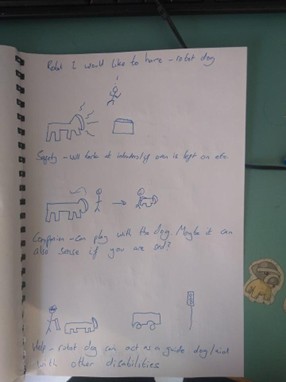
While robots would be good to be used for cleaning and other such chores, Henry worries that it would make us lazy. He also mentions that we already have smart fridges, and so he’s not sure how much more we could create without it being to our detriment. Using robots for childcare would be useful, such as in situations where children shouldn’t be left home alone, and it would help create free time for the parents, but it is important for children to learn from their parents and other humans in their lives. On the other hand, when thinking of care for elderly people, we would need to make the robots more accessible so that they wouldn’t feel as uncomfortable and out of place with newer technologies. It would be useful in helping with chores and provide a useful way for monitoring their health and alerting their families if something’s wrong, but it would also allow for elderly people to have more independence in living on their own. He thinks having a robot pet would be cool, but only for simple animals, not cats or dogs. He agrees that it is possible to have a sentimental attachment to such machines. However, he says that the point of having a pet is to look after it and having a robot to do that job would be defeating the purpose. The only exception could be in a situation where the family is on holiday, and a robot could be taken care by a robot.
Suggestions for Improving Efficiency with AI at Work
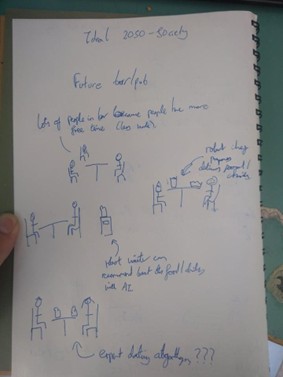
When it comes to AI clients, Henry doesn’t understand it would work, but he doesn’t see a problem with having AI colleagues; some human interactions would still be needed, but they could be used to aid in simple tasks. For more complex jobs, it would also provide some assistance to humans, allowing for less work per week and therefore, more free time. In shops and food places there is already reduced interaction with people, so he doesn’t mind if it was all automated. He points out that when he goes out to eat, he already mostly goes with friends, so the experience is already social, and in supermarkets he simply goes in and out to get the job done, so doesn’t mind there being less people. Using robots in healthcare would hopefully make it more accessible to people, as they could provide more accurate diagnoses, as they have a whole database to consult as opposed to just relying on memory. Surgeries are just a series of actions, so he doesn’t mind a machine doing the movements as long as it is considered reliable. Robots could also complete the more unpleasant tasks in hospitals, such as cleaning. It could also be useful to use robots in schools, such as having them grade tests and aiding in large classes, allowing for students to be split into smaller groups. This would ensure all questions could be answered and give a better understanding. In university, not only could the AI give suggestions to students in what subjects they may want to study based on interests, but could also give advice on essays and reports, similar to the software Grammarly. As a whole, he wants humans to be at the final stage of every process, to assess if the work done by machines in earlier stages is satisfactory.
Cautious Attitude Toward AI in Law and Politics
Henry doesn’t see an issue with self-driving cars, as there’s no reason to refuse to use them if it is proven safer and more efficient, as there will be no instances of drunk driving or other such activity. Due to this, he admits that the culture around transport may be different, where it’ll be cheaper but also only for getting around, and not an enjoyable drive. He is quite worried about more social areas of society, such as law and politics, since the bias from the creators could easily be reflected in the AI, so there needs to be a discussion among humans to avoid echo chambers. If surveillance is handled well with no risks of people’s privacy being invaded then it would be ok, but it could always be used wrong, so he is quite nervous. With emergency services he is quite optimistic, since having robot firefighters would have less risk associated with the job, paramedics could be more efficient, and police would be safer. He also notes that, if the cars are indeed self-driving, then they could automatically move to the side to allow for police cars and ambulances to pass through, being programmed to give priority to other vehicles. In the more global scale, language translators should improve, but since we should have more free time, as robots will be doing a lot of work for us, he thinks people will still want to learn languages as a way to use the time. As for robot soldiers, he doesn’t have an opinion on whether machines or people should be used, as the problems he has are with the act of war itself. However, he admits it can be unfair to use robots in such global issues, as different countries will have different levels technological advancement, so it would be unfair to use them in discussions with one another.
Hopes for Educational Reform and Changes Through Technology
Since technology will only become more advanced, Henry believes the general public should be more educated on it, allowing them to stay up to date and safe. Even though he is fairly comfortable with technology, he would also like to attend such lessons to learn more and satisfy his curiosity. Even at a young age people should be taught about technology, providing coding classes at school. He can see jobs both being lost and created to account for the new technology provided, but acknowledges that people may not be qualified enough for the more advanced jobs, so we would be living on universal income, and education will become essential. However, all this will place an emphasis on creativity, as there would be an abundance of interesting art from both humans and robots, and it would allow for people to focus on new skills and pursue their passions. Overall, he passively accepts new technology, as he is interested but doesn’t believe it to be essential in his life. He hopes for technology to be used in ways that would benefit everyone, as opposed to making the rich richer, but knows that realistically it’ll just be used for corporate gain. Since robots will be so deeply engrained in our society, the ideas of power and responsibility will be muddied, but rather than seeing that as better or worse, it’ll just be different. He also notes that society as a whole may grow to be less intelligent, depending on how it is defined, as we can access more information freely as opposed to having knowledge about a subject. In general, he is quite worried we’ll rely on new technology too much, giving it and therefore the people controlling it too much power.