Ethan is 25 years old and a graduate student at a medical school in the northeastern United States, where he studies health informatics and machine learning. He uses AI every single day — in neural networks for his research, through Siri and other smart devices, and for personal projects like NBA data analytics. He is, in short, someone for whom AI is not a future prospect but a present reality.
Living Inside the Technology
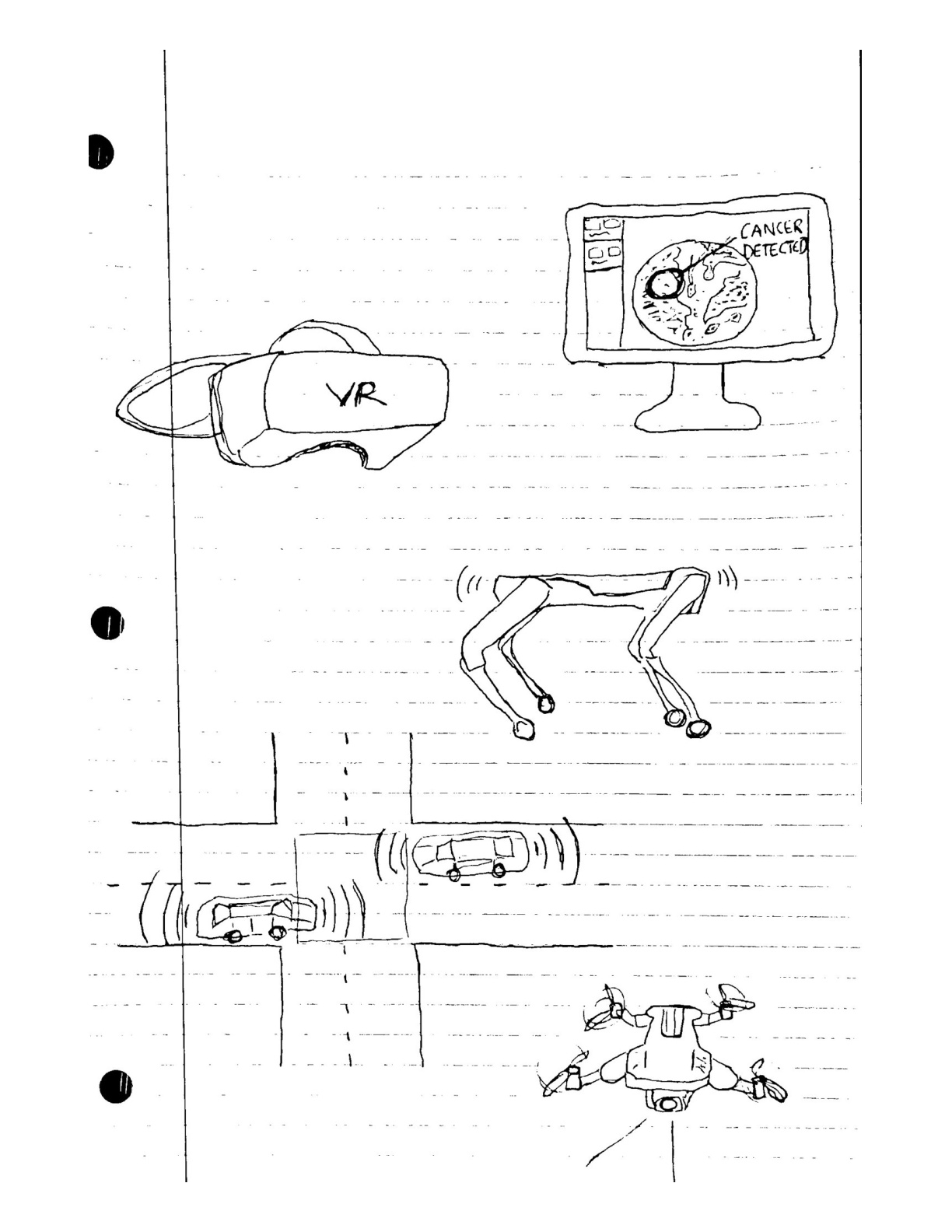
For Ethan, the line between AI and daily life has already dissolved. “Day to day, I’m consistently using AI in the forms of neural networks and simpler algorithms. Then probably with things like smartphones — I’m using Siri a little bit here and there. And for fun, things like NBA data analytics.” By 2050, he hopes to be a physician applying machine learning to clinical settings, commuting in a self-driving car, and working in a field of advanced remote patient monitoring. He envisions a society where many people inhabit a Metaverse-type world — spending significant time in VR for work, games, and social connection, fulfilling experiences that are increasingly difficult to access in the physical world.
AI in Medicine: His Clearest Vision
Healthcare is where Ethan’s thinking is most detailed. He wants AI handling medical imaging (“that would free doctors to work on edge cases and spend more time face to face with patients”), and taking over routine data entry that carries risk of human error — drug dosages, patient records. For nursing homes, he envisions AI managing medication reminders, personalized nutrition, and early disease detection, similar to what an Apple Watch already begins to do. He particularly moves when describing AI giving music therapy to Alzheimer’s patients: “I saw this beautiful documentary — playing songs from their era, maybe even putting them into VR that recreates the days of their youth. It stimulates great memories and helps with easing out of life with a degenerative brain condition.”
Bias Is the Real Danger
On AI in hiring and society more broadly, Ethan is more cautious. “The systems that we train continue to retain our own biases. Those biases will be reflected in hiring processes.” He sees facial recognition and crime prediction systems as examples of this already happening. At the global level, he extends the same concern: “A North Korean AI system will probably not give you the same results as a United States one — it would just amplify the values that their creators have endowed them with.” His clearest critique is not of AI itself, but of unexamined human assumptions being encoded into supposedly neutral systems.
Trust, Shape, and the Boston Dynamics Dog
Ethan’s trust in AI is highly task-dependent. He trusts it for image recognition and document scanning, but not for writing an email — “Even GPT-3, the newest greatest language model? I wouldn’t trust it to write an email for me yet.” His preferred robot shape is animal-like rather than humanoid: “I like the Boston Dynamics dog. I think it’s cute. The cheetah they build over there is nice — not too threatening.” He is an early adopter in principle (“I got on the waitlist for every beta AI system as soon as they came out”) but acknowledges that resource constraints slow him down in practice: “Until two weeks ago I had an iPhone 6. I’m a grad student. It is what it is.”
Meaning, Not Busy Work
On the future of work, Ethan is thoughtful and hopeful. He believes repetitive jobs will decline while meaningful ones increase — particularly those involving human oversight of AI systems. “If jobs are created that are more towards meaning, you could direct a lot of that manpower towards solving problems still yet to be solved: alleviating certain diseases, better allocation of resources in impoverished countries.” His vision of societal happiness through AI is similarly human-centered: “Eliminating a lot of busy work would free up people’s time for more human engagement — especially with their families. The United States has kind of a work addiction. Turning towards individual relationships, strengthening the family — that’s the way society would find more happiness through automation.”